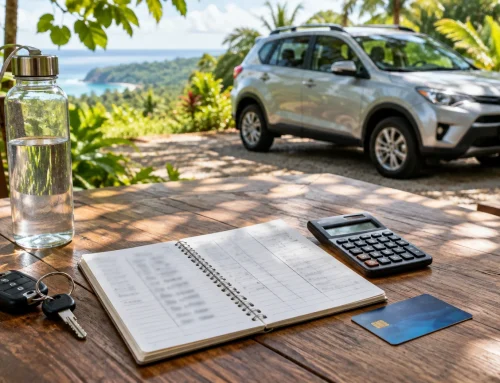



Renting a car in Costa Rica: how to choose without unpleasant surprises
To choose a rental car in Costa Rica, start with your itinerary, then compare quotes on the same basis: rental period, category, coverage, deposit, extras and return. A daily rate alone will not tell you which offer is the best value. The right reservation is one whose final cost and terms you understand before paying.
Start with the route, not the car
Imagine two fifteen-day trips. On the first, you spend several nights in La Fortuna and then at a beach served by the usual main roads. On the second, you have booked a remote house reached by a difficult final stretch, and you plan to change regions often. Your needs are not the same, even if both trips are called a “road trip in Costa Rica.”
Get a map and mark your accommodations. For each stop, check the actual access, not just the distance. A secondary road may require a particular type of vehicle; an unpaved road impassable for certain categories may even be excluded under the rental terms. A message to the property owner a few days before departure may be more useful than a general list of the “best SUVs.”
Check the available space too. Four travelers and four suitcases will not necessarily fit comfortably in a small car. Child seats, legroom, air conditioning and secure luggage storage are worth comparing when you choose a category.
Compare three quotes on a single sheet
To avoid misleading comparisons, open two or three offers with exactly the same dates, times, pickup and return locations, number of drivers and a similar category. Then record each final price rather than the small amount displayed on the results page. On your sheet, create four rows: what is included; what is mandatory or charged at pickup; what remains optional; and what will only be held as a deposit. That last row is important. An amount placed on hold is not necessarily spent, but it reduces the credit available to you during the trip.
Add a column for cancellation terms and any one-way fees. A cheaper quote may still be the best, provided you compare equivalent services. Without this method, you may be comparing an almost bare-bones car with another that already includes several protections.
Read the insurance terms without being intimidated by acronyms
You will often encounter TPL, CDW and other acronyms. Resist the temptation to assign them a universal contractual meaning. Their precise scope depends on the rental company, the contract you sign, the exclusions and sometimes the booking channel.
Ask for the important points in writing: which damage is covered, the amount of any deductible, the required deposit, driving exclusions, authorized drivers and the procedure in the event of a claim. Reimbursement protection offered by an intermediary may work differently from local insurance: in some cases, the rental company first charges you and you must then seek reimbursement under the third party’s terms.
If a condition is ambiguous, have it clarified before paying. Prefer a written response to a verbal reassurance such as “don’t worry.”
Prepare for pickup and return
Before your trip, check the required payment card, the primary driver’s name, the accepted driver’s license, opening hours and the exact pickup location. “At the airport” can mean a counter in the terminal, a meeting point nearby or a shuttle to an off-site office: each makes for a different start to your trip.
At pickup, take photos or a video of the vehicle’s condition, immediately report any damage not recorded and check the tires, lights, fuel level and assistance instructions. For the return, allow extra time if your flight leaves early: a shuttle or inspection may take longer than expected. Finally, do not schedule your longest driving day immediately after an intercontinental flight. A night’s rest can make the rest of the trip much more enjoyable.
When a car is not essential
If you are staying in one region and have already planned excursions with transportation included, shuttles or transfers may be suitable. For multiple stops, a car often gives you more independence, but it also adds driving, parking, the rental contract and associated costs.
The question is not “Do I absolutely need to rent a car?” but “How many days do I really need a car?” Renting for part of your stay may sometimes fit your itinerary better. Simply compare pickup and return costs and the cost of any remaining transfers. Is a 4×4 always necessary? No. The need depends on the actual route, the season, the final approach to your accommodation and rental restrictions.
Can you rely on the price displayed by a comparison site?
It is a starting point. You need to check the coverage, fees, deposit, driver and return terms in the final offer.
Does your quote accommodate your itinerary?
Before comparing brands, test two offers against the same day of travel. As an illustrative example: you leave La Fortuna, spend a few nights on the coast and return the vehicle before your flight. Ask each agency whether this sequence of stops complies with the contract terms, then add return fees, the additional driver and family equipment. The comparison concerns an entire reservation, not a “per day” price label.
| Point to compare | Offer A | Offer B |
|---|---|---|
| Guaranteed category | Ask for clarification | Ask for clarification |
| Amount actually payable | Rental and extras | Same scope |
| Deposit on hold | Separate from the price | Separate from the price |
| Final approach to the accommodation | Compatible or route to be revised | Same check |
A vague written response is information in itself: you do not yet have a comparable quote. It is better to resolve this calmly before departure than to discover a difference at the counter. Also keep the version of the terms you accepted; a sales page may change after you book.
A first choice that changes everything: how many days behind the wheel?
Before renting for your entire stay, plot your stops on a map. If you spend the first three nights near accommodation offering transfers and excursions with pickup, having a car available immediately may not be essential. Conversely, if you plan to explore several beaches or change bases often, it can offer valuable freedom.
To decide, compare two plans for the same dates: a car from the first day to the last, and then a rental limited to the days when you will actually be traveling. Add the cost of transfers, any pickup fees and the time needed to reach the agency to both. The right contract depends first on the pace of the trip, not the size of the advertised discount.
Frequently asked questions
 Numa Costa
The pen name under which I publish my articles and develop my editorial websites. Curious by nature, I enjoy understanding how things work, exploring everyday questions and making information easier to understand and use.
→ Learn more about the author