

Renting a 4×4 in Costa Rica: when is it useful?
No, a 4×4 is not essential for every trip to Costa Rica. The choice depends on the roads you will actually take, the season, and the final stretch to your accommodations. A standard car may be suitable for some tourist itineraries, while greater ground clearance or a suitable drivetrain may be useful on other routes. The map and rental terms should guide your decision.
The mistake: choosing based on the country’s reputation
Costa Rica has a mix of main roads, secondary roads, and more difficult access routes. It is not reasonable to claim that “you can go everywhere in a city car” or that “you need a 4×4 everywhere.” Both answers ignore your itinerary.
An over-equipped vehicle often costs more and may be less practical because of its size. Conversely, a very low vehicle may be poorly suited to a final stretch of rough road. The right choice avoids both unnecessary expense and an impassable access route.
Three questions to ask your accommodations
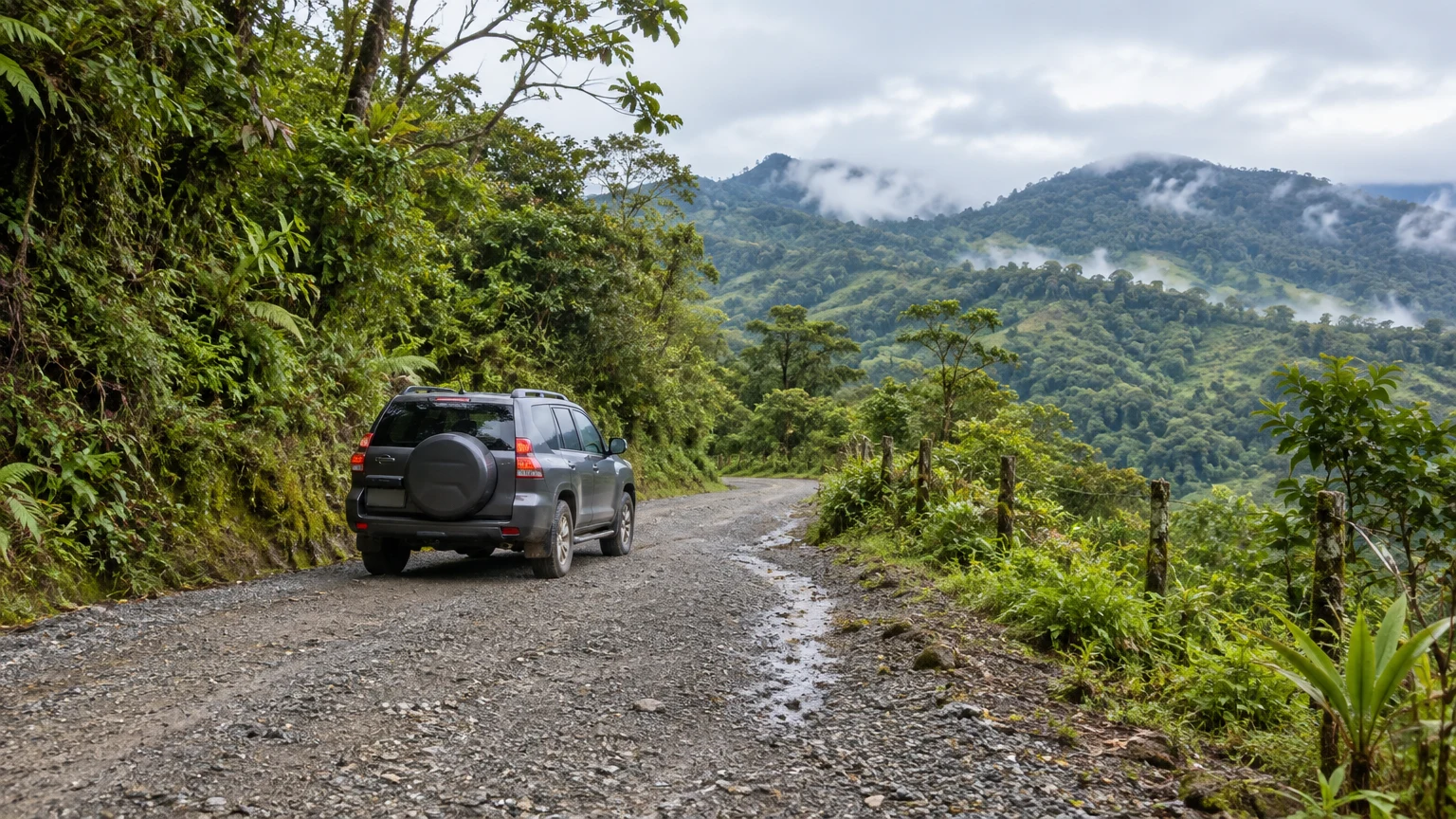
First question: are the last few kilometers on a paved road, gravel, or an uneven track? Second: does access change significantly during heavy rain? Third: what vehicle category does the accommodation recommend for your specific travel dates?
Ask whether the recommendations really concern four-wheel drive or simply better ground clearance. These are not the same feature, and rental agencies sometimes use commercial categories that can be confusing.
On this topic, the guide Driving in Costa Rica: rules, restrictions, and mistakes to avoid provides additional guidance.
Add the answer to your booking records. If getting there requires crossing water or leaving permitted roads, do not treat a 4×4 as permission to do so. Check the rental company’s restrictions and the actual safety conditions.
Rainy season: plan ahead without exaggerating
The Costa Rican Tourism Institute describes a wetter season on the Pacific side from May to October, with transition months. Roads, tracks, and visibility can vary depending on the weather and region. That is not a reason to declare all roads impassable: it is a reason to adjust your route from day to day.
An itinerary with long driving days will benefit from some extra time, particularly when it crosses mountainous areas or less well-served regions. Do not rely on a travel-time estimate based solely on the number of kilometers.
SUV, 4×2, 4×4: check the category you booked
The SUV label does not necessarily guarantee four-wheel drive. Similarly, some higher vehicles may still have two-wheel drive. If you need a specific technical feature, ask the rental company to confirm it and check the category specified in the contract.
At the rental location, a verbally offered upgrade should not distract you from the total price and the contract. The actual vehicle may also differ from the model shown “or similar” on the platform.
A simple decision at the end of your planning
If your accommodations are easy to reach, you plan to use mostly regular roads, and you have not identified any difficult stretches, compare a standard car as well. If several access routes justify it, look at categories that offer the necessary features.
In either case, read the insurance contract for driving exclusions. The best vehicle is not the one that looks most impressive in a listing; it is the one that allows you to make your trip under reasonable conditions.
Are an SUV and a 4×4 the same thing? No. An SUV body style and four-wheel drive are different features.
Do you need a 4×4 to visit La Fortuna or Tamarindo?
Not based on the destination’s name alone. It all depends on the exact addresses, the access routes you take, and driving conditions.
Distinguishing the tourist route from the final access road
A La Fortuna–Tamarindo trip and a stay in a house on a remote slope cannot be compared by distance alone. The deciding factor may be the final stretch to the accommodation. Ask the owner about that specific access route and the time of your stay, rather than asking a general question about Costa Rica.
| Answer received | Decision to make |
|---|---|
| Greater ground clearance recommended for access | Check the category’s ground clearance, not just the word SUV |
| Four-wheel drive required | Confirm a category that guarantees it |
| Access not recommended after heavy rain | Plan for different accommodations or another route |
| Contract excludes the intended crossing | Change your plans, even with a more robust vehicle |
If the only answer is “everyone comes in a 4×4,” ask why: a slope, the surface, potholes, mud, or rental rules. You can then choose for a concrete reason. No equipment turns a flooded or prohibited crossing into a reasonable route.
Ground clearance and drivetrain: two criteria that are often confused
A high-clearance car can still have two-wheel drive, and a four-wheel-drive model is not permission to cross a river or use a prohibited track. Ask the accommodation what really makes the last few kilometers difficult: rocks, potholes, mud, a slope, water crossings, or simply an unpaved road. Then ask the rental company to confirm that the chosen category and the contract permit the journey.
If access is not recommended after heavy rain, change your travel time, route, or accommodation rather than counting on the vehicle to compensate. The best choice is not necessarily the most impressive SUV: it is the vehicle that is permitted and suited to the roads you will actually take.
Frequently asked questions
 Numa Costa
The pen name under which I publish my articles and develop my editorial websites. Curious by nature, I enjoy understanding how things work, exploring everyday questions and making information easier to understand and use.
→ Learn more about the author