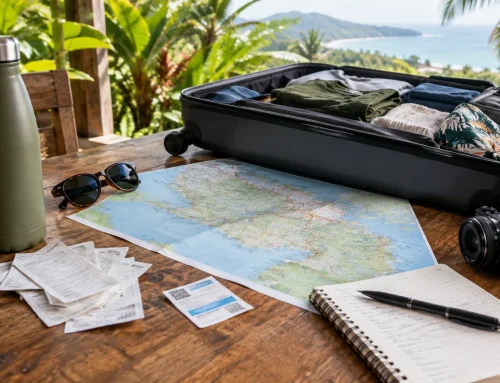



Budget for 15 days in Costa Rica: calculation method
To calculate a budget for fifteen days in Costa Rica, add up flights, accommodations, transportation, meals, activities, insurance, and a contingency allowance. The result must be based on your dates and your group: an average amount found on a blog is not enough to make a decision.
Start with unavoidable expenses
Gather quotes for round-trip tickets, including baggage, then for accommodations on your actual dates. Add transportation between stops: a car with insurance, a deposit to plan for, fuel and parking, or shuttles with airport transfers. The security deposit temporarily held on the card for the car is not a final expense, but it can tie up part of your card limit.
This initial total lets you see whether the itinerary fits your budget before booking excursions. Remember possible accommodation taxes and service fees, as well as surcharges for children or additional drivers.
Build a realistic meal budget
Distinguish between days with breakfast included, restaurant meals, groceries, and excursion days when you take a meal to go. An apartment with a kitchen can reduce your food budget, but only if you want to and are able to prepare meals.
For an initial estimate, create three daily spending scenarios, then compare them with recent menus and prices in your chosen regions. Do not use a single amount for the whole country, particularly when comparing heavily touristed resorts with less-visited towns.
Activities: allocate a spending limit rather than booking everything that appeals to you
Choose two or three priority experiences and find out their full price: admission, guide, transportation, equipment, and any taxes. Entry to some parks is booked through SINAC. Check the nonresident price and the category for children when booking. Set aside an amount for an activity you discover once there, without assuming it will be available at the last minute. A well-prepared budget should leave a little freedom, not turn every morning into an unexpected expense.
The final table to build
Line 1: flights. Line 2: nights, taxes, and fees. Line 3: transportation. Line 4: meals. Line 5: activities. Line 6: insurance, communications, and incidental expenses. Line 7: safety margin. You may divide by the number of adults, but keep the family total as your cash-flow reference.
The actual cost is confirmed with comparable quotes, not with an “average” estimate presented as universal. Keep your quotes and dates: the budget can then be updated without starting over.
An illustrative budget for fifteen days
The following table covers two adults and fourteen nights. All amounts are fictional, in euros, and serve only to demonstrate the method. They are neither a national average nor a quote valid for your vacation.
| Item | Calculation assumption | Fictional total |
|---|---|---|
| Flights | Two tickets at 850 € | 1 700 € |
| Accommodation | Fourteen nights at 95 € | 1 330 € |
| Transportation | Allowance based on your quotes | 850 € |
| Meals | Fifteen days at 60 € for two | 900 € |
| Activities | Five outings at 90 € for two | 450 € |
| Other planned expenses | Insurance, communications, and equipment | 250 € |
| Total before contingency | Sum of the items | 5 480 € |
Replace each assumption with your own figures, then examine what really changes the result. Cutting two excursions at 90 € saves 180 €; choosing nights at 80 € instead of 95 € saves 210 € over fourteen nights. That does not mean you should choose the cheapest option: you simply see where you have room to make decisions.
The contingency reserve and deposits should remain visible separately. An amount held for the car can reduce the money available without immediately increasing the final cost. To find out what remains to be funded, also distinguish between the total trip cost and amounts already paid.
Review the result before looking for savings
Classify each item in one of three states: an amount confirmed by a booking, an estimate based on a dated source, or an undecided option. Two budgets showing the same total are not equally reliable if one is based almost entirely on assumptions. Therefore, also note what remains to be confirmed. This review will tell you where to look for the next quote, without spending as much time on every small expense.
Then create a second version of the budget with just one major change: one fewer base, a different type of accommodation, or one major excursion removed. Compare the savings with what you actually lose. A saving of 200 € over fifteen days does not have the same value if it takes away your favorite experience as it does if it eliminates a journey you did not want to make.
Finally, keep expenses per traveler separate from group expenses. Plane tickets are calculated per person; a private transfer or a room can be shared. This separation prevents you from overestimating or underestimating the cost when someone joins the trip. It becomes particularly useful if you compare a trip for two with a family trip.
A numerical example to understand the budget, not predict prices
Imagine two adults for fifteen days, with fictional expenses in euros: 1 700 € for flights for two, 1 350 € for accommodations, 650 € for meals, 750 € for local transportation, 500 € for activities, and a 250 € margin. The total for this simulation is The second simulation uses assumptions different from the first (items, amounts, and margin). To avoid a misleading comparison, keep a single detailed example, with its reserve clearly separated from the total, or display a table mapping the assumptions before any second total. for two people, or 2 600 € per traveler. These amounts are not prices observed in Costa Rica and do not constitute a market estimate: they only show how to allocate a budget.
To calculate your own figure, replace each line with a quote, a verified price, or a clearly noted personal assumption. If flights exceed your budget, first look for another date or airport. If accommodation costs more than expected, compare nights in each region rather than sacrificing all activities. Remember to distinguish between amounts paid, those still to be paid, and bank deposits temporarily held.
Finally, keep two scenarios: the planned budget and the budget with a margin. You will not have to spend it all, but you will have planned for small variations without having to recalculate your vacation budget every morning.
Frequently asked questions
 Numa Costa
The pen name under which I publish my articles and develop my editorial websites. Curious by nature, I enjoy understanding how things work, exploring everyday questions and making information easier to understand and use.
→ Learn more about the author