

Renting a car in Costa Rica during the rainy season
Renting a car in Costa Rica during the rainy season is still possible for many itineraries, but it requires more flexibility. You need to adapt your route, check access to accommodations, favor daytime travel, and never attempt to cross a flooded road. The type of vehicle is only part of the answer: local conditions and contract restrictions matter more.
Green season does not mean the same weather everywhere
On the Pacific coast, the wet season is generally more pronounced from May to October, with transitions that vary by region. The Caribbean weather pattern follows a different rhythm; September and October can even bring relatively drier periods to certain stretches of the Caribbean coast. The mountains add their own microclimates.
For a traveler, this means that a national average is not enough to choose a car or an itinerary. A trip limited to main roads does not involve the same constraints as one with a steep private access road, even if both trips take place in July.
Our When to Go page and Local Weather will help you focus on the region and month. Favor this nuanced reading over the blanket advice to “take a 4×4 from May to November.”
A road can be passable in the morning and difficult later
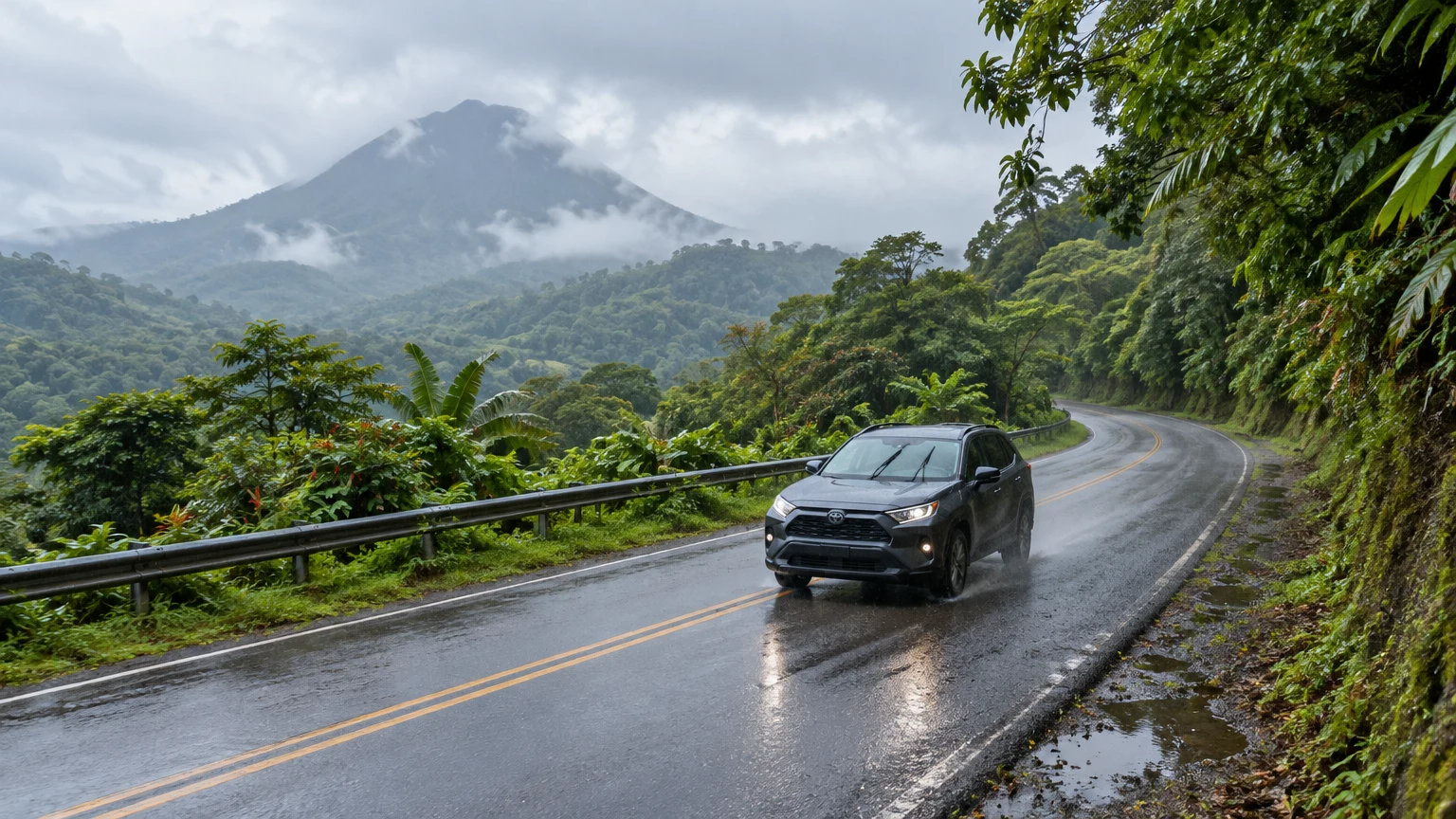
Rainfall can affect traction, visibility, and the condition of some secondary roads. French and British authorities note, in particular, the risk of potholes, flooding, and landslides during periods of heavy rain. Before a day of travel, ask both the accommodation you are leaving and the one you are heading to which road is currently recommended. GPS routes that are theoretically shorter may use unsuitable or temporarily damaged access roads.
Plan long legs early in the day when conditions allow, but do not treat that as a guarantee of good weather. Check alerts and keep a backup plan, especially when an activity requires you to arrive at a set time.
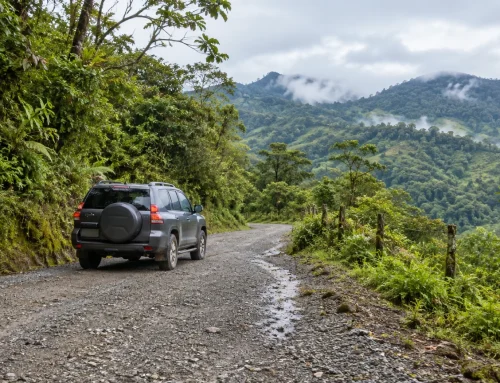
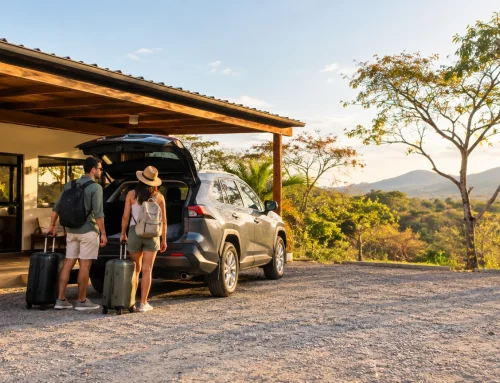
4×4, SUV, ground clearance: do not confuse them. An SUV can offer more space and greater ground clearance than a city car without necessarily having all-wheel drive. A true 4×4 can help on some difficult, permitted access roads, but not at a severed bridge, a flooded river, or a prohibited crossing.
Ask your accommodations whether there is an unpaved section, a steep climb, or a tricky access road. Then check with the rental company that the chosen category and the contract actually permit the trip. An exclusion concerning fords or tracks could leave you responsible for substantial expenses.
For a trip entirely within cities or on main roads, a lower vehicle category may still be suitable. The decision depends on the last mile of each leg, not on a photograph of a tropical road.
Five driving habits that matter more than the vehicle category
Keep your distance, slow down before tricky sections, avoid abrupt maneuvers, and be cautious on narrow bridges. US authorities warn about unpaved secondary roads, inadequate road markings, and the danger of water crossings; they recommend avoiding night driving outside populated areas as much as possible.
A puddle can conceal a hole or hide the depth of a flooded area. Never cross a flooded road. The depth and the stability of the road surface may be impossible to assess from the vehicle; turn around and look for a permitted route. In the event of a detour or a closed bridge, never go around a roadblock on the grounds that an app still suggests that route.
Download offline maps before departure, but also use recent information from locals and authorities. Navigation shows a route; it does not confirm that it is passable.
Building an itinerary with room to spare
Over ten or fifteen days, three well-chosen regions are better than six stops that become vulnerable at the first setback. Keep days free around long transfers and favor activities that can be changed during uncertain periods.
Keep essential stops and activities that can be postponed clearly separate. Save your confirmations offline and check the change conditions before booking a nonrefundable service.
Before paying for a nonflexible booking, check whether you can change an accommodation or excursion if an access road becomes impassable. That may be more valuable than paying for a higher vehicle category. Is a 4×4 mandatory during the rainy season? No, not as a general rule. The category you need depends on the specific roads and access routes, as well as the rental company’s terms.
Should you cross a shallow river?
Do not attempt to drive through a flooded crossing or across a river. Even apparently shallow water can hide a current, a hole, or a damaged road surface. Turn around and ask for a permitted route.
Planning a day with a real weather buffer
For a leg between two regions, do not schedule a nonrefundable excursion immediately after the arrival time estimated by an app. Instead, set aside the afternoon to settle in. If the journey goes normally, you will have free time; if it slows down, you will not have to choose between driving under pressure and losing a booking.
On the morning of your trip, ask the accommodation about the condition of the final access road and check the relevant official alerts. A road photograph sent the previous week may be useful without showing the situation on the day. If access is not recommended, work with the people concerned to find an accommodation or travel solution.
| Change observed | Practical response |
|---|---|
| Arrival expected after dark | Leave earlier, shorten or postpone the leg |
| Crossing reported flooded | Do not attempt to cross |
| Final access uncertain | Ask for a permitted solution to be specified |
| Activity canceled | Check the refund and alternatives before traveling far again |
In green season, protect the buffer in your day
Heavy rain can affect visibility, road conditions, and travel times. Favor a schedule that does not require you to arrive at an exact time after several hours on the road. If a secondary access road is uncertain, ask the accommodation and rental company before departure; do not assume that a 4×4 overrides contract restrictions.
Carry your bookings offline, plan a place to take a break, and avoid taking a flooded or unfamiliar crossing. The green season can be magnificent, with lush landscapes. It becomes more enjoyable when you allow the weather to change a small part of the plan without compromising the entire itinerary.
Frequently asked questions
 Numa Costa
The pen name under which I publish my articles and develop my editorial websites. Curious by nature, I enjoy understanding how things work, exploring everyday questions and making information easier to understand and use.
→ Learn more about the author