


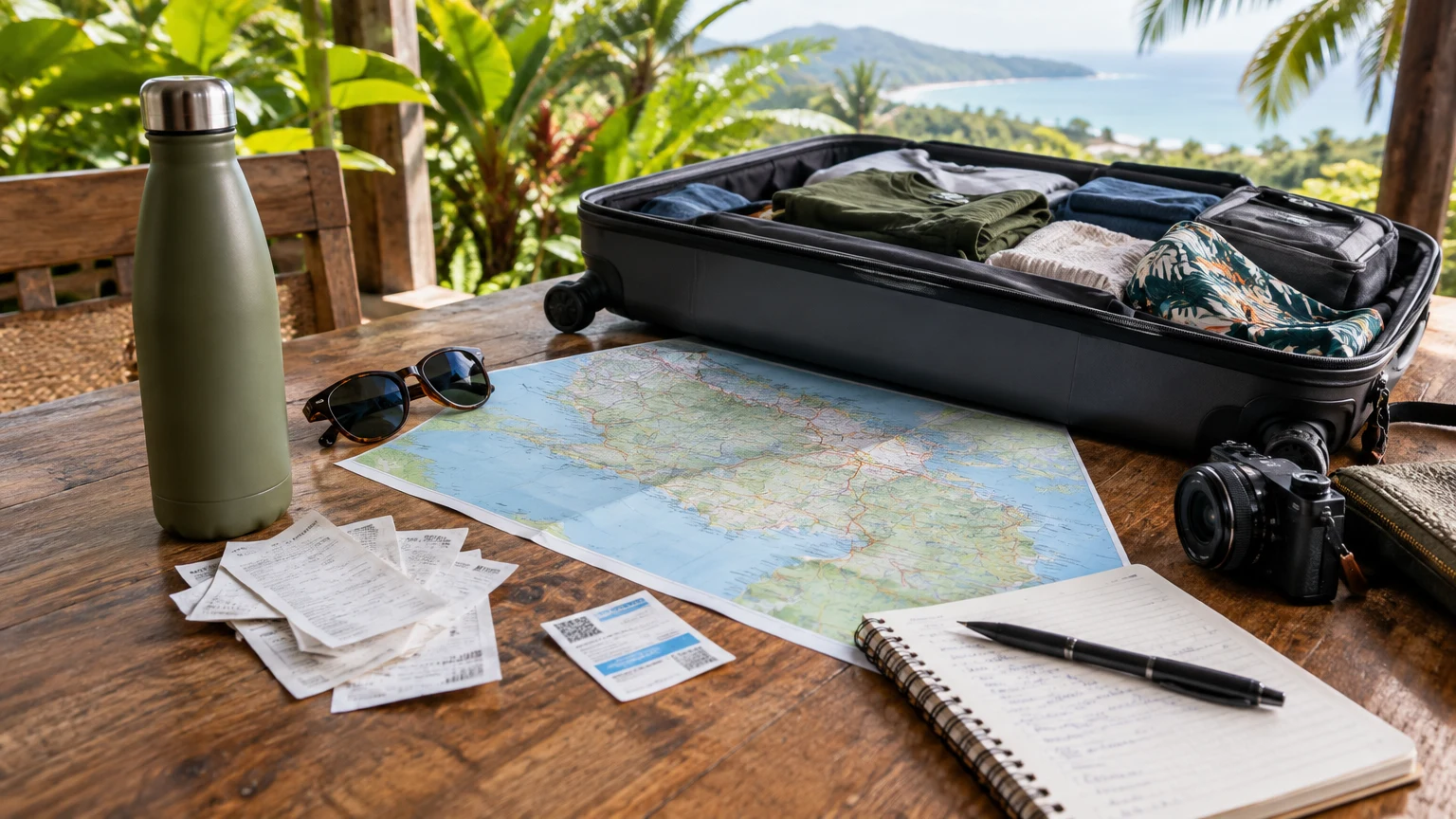
How to plan your Costa Rica budget without forgetting incidental expenses
A complete Costa Rica budget should include the smaller expenses that comparison sites do not always show: transportation from the airport, insurance, baggage, bank fees, parking, possible tips, equipment, communications and unexpected expenses. It is often their accumulation and repetition that throw the total off balance.
Hidden expenses before arrival
Before departure, you may need to pay for extra baggage, transportation to your departure airport, an overnight transit stay, travel insurance, mobile data or rain gear. For a family, not all of these expenses can simply be multiplied by the number of people, which is why a detailed list is useful.
A credit card used as a rental guarantee may have a sum placed on hold without it being permanently charged. You should plan for this effect on your credit limit separately from your spending budget.
Recurring daily expenses
Fuel, possible tolls, parking, coffee, snacks, laundry, water or other drinks and small purchases may seem negligible. Added up over two weeks, they deserve a separate budget line. The point is not to account for every coin before departure, but to avoid forgetting all of them.
The number of times you change accommodations affects these costs: days on the road, meals eaten out for lack of a kitchen, gas station stops and quick purchases sometimes multiply when the itinerary is too packed.
Outings: look beyond the ticket
For an excursion, ask whether transportation, the guide, equipment, park admission, taxes and the meal are included. SINAC reservations and private excursions should be considered separately. An apparently inexpensive activity can entail an expensive transfer from a distant hotel. Check the refund conditions. An activity postponed because of the weather may create an extra journey, an additional night or a replacement day, which calls for some financial flexibility.
Create a proper emergency reserve
After accounting for confirmed expenses, set aside a buffer for a breakdown, a medical consultation, a change in transportation or an expense that cannot be anticipated. The size of this reserve depends on your budget and insurance coverage: it should not be presented as a universal percentage.
In your records, separate expenses already paid, amounts to be paid on site, deposits held and the reserve. This distinction helps you see how much money will actually be available during your vacation.
When you return, replace the expected expenses with the amounts actually charged. In the column for amounts on hold, indicate which guarantees have been released or are still pending; a guarantee that was never counted as an expense should not be “deducted” from the cost of the trip.
A financial checklist before departure
Use four separate columns: total expected cost, already paid, to be paid on site and amount temporarily on hold. Add a separate reserve for changes of plan. This table helps avoid counting a deposit as a final expense or forgetting a service already paid for in the cost of the vacation.
| Item | How should it be classified? |
|---|---|
| Airfare paid | Trip cost and already paid |
| Room payable on arrival | Trip cost and still to be paid |
| Car rental guarantee | Amount on hold to plan for separately |
| Excursion option not booked | Optional expense, not a confirmed commitment |
| Unexpected change of overnight stay | Reserve used if necessary |
Example: a weather-related cancellation requires 65 € in transportation and an additional night at 90 €, but frees up 80 € from a refunded excursion. The hypothetical net effect is 75 €, provided the refund is actually received. The immediate need for money may be greater if the refund arrives later. This shows the difference between final cost and available funds.
See what remains to be funded without mixing up the categories
Hypothetical example: the trip is budgeted at 7 000 €, of which 4 000 € has already been paid. That leaves 3 000 € in confirmed expenses. If a guarantee equivalent to 1 200 € must be placed on hold and you want a reserve of 600 €, the financial capacity you need to arrange for the remainder reaches 4 800 €, under these assumptions alone. This does not turn the trip into a final expense of 8 800 €: the guarantee and the reserve serve distinct purposes.
When you return, replace the estimates with the actual amounts, then remove the guarantees that have been released. This final step helps you understand the cost of the vacation without keeping an amount that was merely held during the stay among the expenses.
The expense often missing is a last-minute decision
A travel budget seems complete when it includes flights, hotels, car rental and activities. Yet discrepancies also arise from small choices: an extra child seat, lunch during a transfer, a nearby overnight stay after a late arrival, a toll, baggage not included or a postponed excursion. These expenses do not call for an endless list, but for room to make decisions.
Go through your itinerary day by day. Highlight the days that combine driving, a reservation and a change of accommodations: they are often the most exposed to unplanned costs. For each one, identify a fallback option. If your flight is delayed, can you reach your first night’s accommodations? If a boat trip is canceled, will you get your payment back or be offered a postponement? If you have to leave a deposit, will you still be able to use your credit limit?
Then manage three separate figures: total expected cost, money left to pay and funds temporarily on hold. The first tells you what the stay costs; the second helps you track expenses; the third helps you avoid an unpleasant card surprise. This distinction prevents a budget that is very detailed on paper from becoming impractical once you are there.
Frequently asked questions
 Numa Costa
The pen name under which I publish my articles and develop my editorial websites. Curious by nature, I enjoy understanding how things work, exploring everyday questions and making information easier to understand and use.
→ Learn more about the author