

Paying in Costa Rica: bank cards, cash and fees
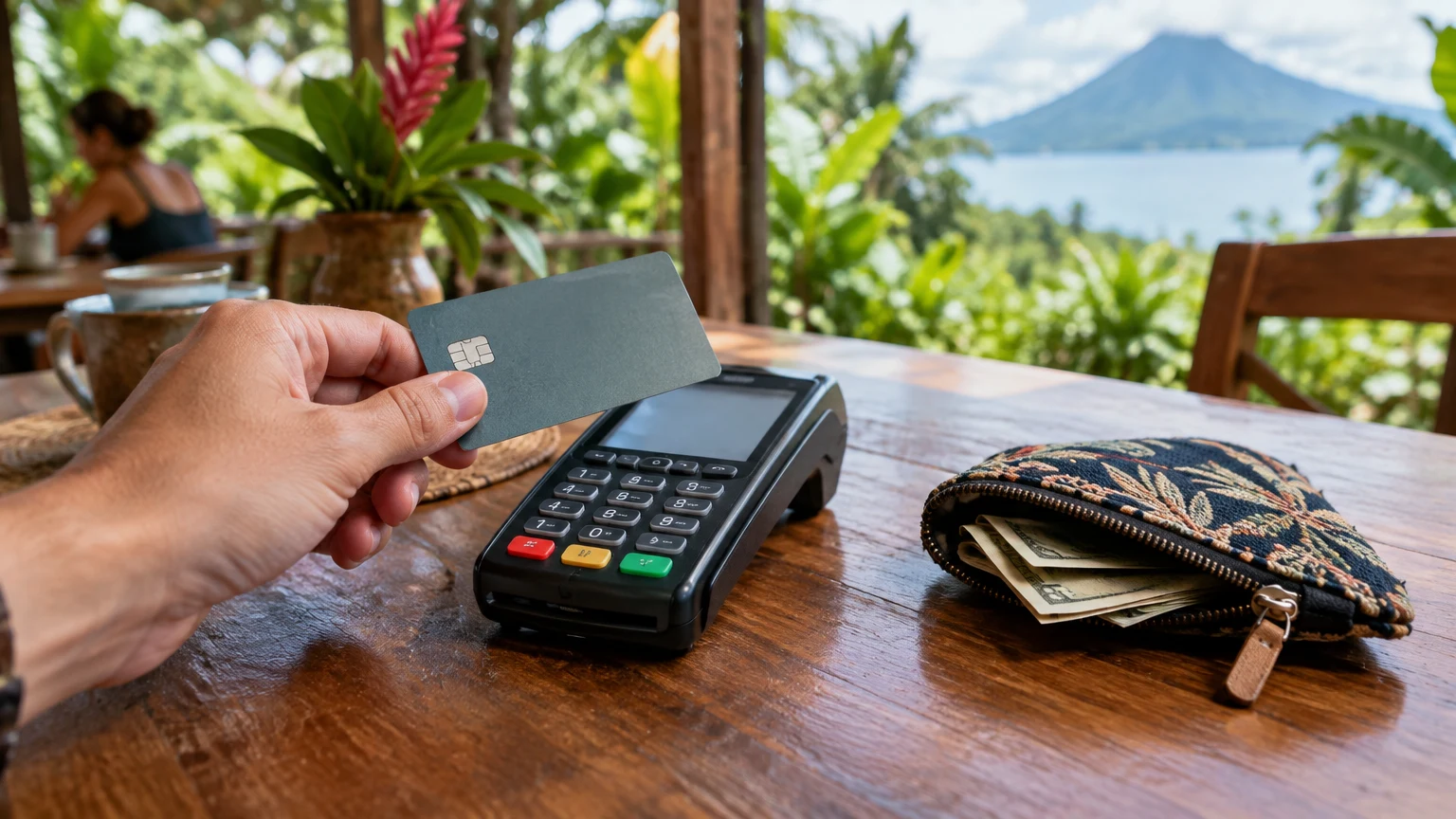
In Costa Rica, the colón is the national currency, and international cards are commonly accepted at many tourist-oriented businesses. Even so, keep a small reserve of cash for expenses where paying by card is not practical, and check exchange or withdrawal fees with your bank.
Visa and Mastercard are widely used at tourist establishments, though acceptance is not guaranteed at every small business. Cash may work better at local markets and for some transportation or local services.
Dynamic currency conversion deserves attention
A terminal may offer to charge you directly in euros rather than in the local currency. This conversion offered by a provider is not necessarily advantageous; compare your card’s terms before accepting. Your bank may also charge fees abroad or withdrawal commissions. No card is automatically fee-free simply because it has a premium label. Check your fee schedule for payments and withdrawals outside the eurozone, as well as any limits and insurance coverage.
Withdrawals: choose secure locations and reasonable amounts
France Diplomatie recommends using ATMs attached to banks rather than isolated machines. Fees may apply, and limits vary. There is no need to withdraw large sums in advance, but having a little cash makes small purchases easier. Keep cards and cash separately, and do not leave valuables in a vehicle. When renting a car, do not use your entire available limit if a large deposit must be preauthorized.
Understanding the cost of a payment at the terminal
This article covers choosing a payment method and understanding fees. To learn how to read currency amounts and plan an EUR–CRC–USD budget, see the guide “Money in Costa Rica: colón, dollar and payments”.
Illustrative example, with no real exchange rate: a purchase is equivalent to €100 before fees. One conversion option offers a charge of €108; your other option would cost €103, based on a banking assumption you should verify. The difference is €5. To make an actual choice, you need to know the amount in the merchant’s currency and your card’s terms; do not infer the outcome from this fictional example.
| Situation | Question to ask |
|---|---|
| The terminal offers euros | What total and conversion rate will be applied? |
| A withdrawal displays a fee | Is it in addition to your bank’s fee? |
| A business accepts several currencies | What is the price, and what currency will change be given in? |
| A deposit is required | How much of your limit will remain available afterward? |
Have a second payment method that you can actually use, and keep it separately. It does not replace the card required for a deposit, but it can help with everyday expenses if a card is blocked or declined.
Prepare a backup you can actually use
Before leaving, make a note of how to contact your bank and check that you will be able to verify your identity from abroad. A second card is only a solution if it is active, accepted for the intended use and kept separately. For the car, also check which card the contract requires: a backup card suitable for meals does not automatically replace the one required for the deposit.
If a merchant presents a transaction you do not understand, ask for the amount and currency before confirming. If a payment is declined, avoid making repeated attempts without checking the messages and receipts; then verify what was recorded. Keeping the receipt and the time of the transaction helps you ask the bank a precise question.
Describe a disputed transaction with the right information
If you do not recognize an amount, gather the date, merchant, currency, receipt and recorded charge. Also check whether it is a deposit hold or an expense. You can then contact the bank and the provider with a precise question, rather than immediately concluding that you were charged twice or that the conversion was incorrect.
For a significant transaction, take a few seconds before confirming: check the total amount, the currency used and the service concerned. Ask for a receipt and keep it somewhere private. This small routine is particularly useful when several reservations are paid for on different dates and in several currencies. Tracking exchange rates and your budget is covered in “Money in Costa Rica: colón, dollar and payments”; here, checking a payment remains focused on the specific transaction.
Card or cash: use a mix rather than choosing sides
In Costa Rica’s tourist destinations, paying by card can be convenient, but exactly how it works depends on the establishment, the terminal and your bank. A small reserve of local cash remains useful for some expenses. This does not mean you need to carry large sums: ask your accommodation which local expenses actually require cash.
On the terminal, check which currency you are being offered to pay in. A conversion offered by the merchant or terminal may differ from your bank’s; ask about the terms rather than choosing at random. For a withdrawal, distinguish between the ATM fee, your bank’s fees and the conversion rate. Keep useful receipts and avoid taking an exchange rate you saw several weeks before departure as a given.
One simple method is to make a note of three columns: currency of the price, amount paid and amount ultimately charged in euros. You can then track expenses without mixing dollars, colones and euros. The Budget guide is better suited to planning your overall trip budget; here, the goal is to pay with peace of mind and understand the actual fees.
Read also: bank cards and payments.
Frequently asked questions
 Numa Costa
The pen name under which I publish my articles and develop my editorial websites. Curious by nature, I enjoy understanding how things work, exploring everyday questions and making information easier to understand and use.
→ Learn more about the author