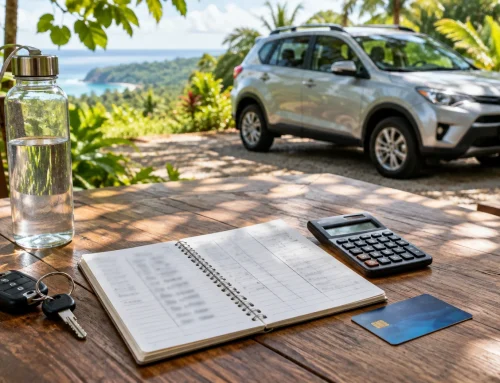



Rental car deposit in Costa Rica: how to plan ahead
A rental car deposit in Costa Rica is a financial guarantee that the rental agency may place as a hold on a card at the start of the contract. It is not automatically an expense, but it can reduce your available card limit during your stay and for a few days after you return the vehicle. Plan ahead for the exact amount, the type of card required and the time it takes for the hold to be released.
Why the deposit is not the price of the car
A preauthorization is like reserving part of your available payment capacity. The agency protects its interests in case of expenses or damage covered by the contract. While the guarantee remains on hold, the amount can reduce what your bank allows you to use, even if it has not been permanently charged.
Imagine a carefully calculated vacation budget: you have enough for hotels, meals and excursions, but the deposit ties up a significant portion of your available funds. You have not exceeded your planned budget, yet you may find yourself unable to pay for accommodations. The pitfall is a matter of cash flow, not just price.
That is why the deposit amount deserves its own line in your travel budget. It should not be added to your final expenses as if you were certain to lose it.
How amounts are determined: two real examples
The policies reviewed show that practices are not uniform. In its FAQ, Alamo Costa Rica states that the deposit is associated with the estimated rental amount and an additional amount of 500 dollars. Budget Costa Rica states that the amount depends in particular on the vehicle category, the country where the card was issued and the protections selected. This information should be checked again before use; it does not represent a national average.
A quote may show the deposit in dollars even though your card is managed in euros. The exchange rate used by the bank, any fees it charges and the time of the transaction can affect how much of your available limit is actually held. To compare two offers, note the deposit amount and currency separately from the final price.
Insurance and protections can change the guarantee requirements of an offer, but never automatically assume that “full coverage” means “zero deposit.”
Check your limits before departure
Start by checking your bank limits, any other deposits already on hold, the hotel amount still to be paid and whether your card can handle a foreign-currency transaction. A daily limit and a rolling payment limit can complicate the situation in different ways.
If your bank allows a temporary increase in your limits, request it before your flight, after obtaining the expected amount from the agency. Do not plan your cash flow on the assumption that the money will be available the day after you return the car.
Keep the bank’s contact details and the rental company’s confirmation on your phone. If you can use two cards, ask whether the agency allows one for payment and the other for the guarantee; do not assume this is permitted.
At pickup and return: keep useful documentation
At the counter, check the preauthorization receipt and the amount shown on the contract. Take dated photos of the vehicle from several angles, report any damage not already noted and check the fuel policy. These are simple steps that reduce unnecessary disagreements.
When you return the car, ask for the closing document and proof that the deposit has been released, if available. Alamo’s FAQ distinguishes the release made by the rental company from the bank’s processing time, which it says can take several business days. A refund of an amount that was actually charged sometimes follows a different process.
If the hold remains beyond the stated time frame, first contact the agency with your contract and supporting documents, then contact your bank. A transaction that is still visible in your banking app does not by itself prove that a final charge has been made.
A small table instead of a rough calculation
For each quote, record five details: final price, required deposit, deposit currency, accepted card and stated release time. Add a sixth column: what the agency actually charges if you return the vehicle elsewhere or with less fuel. You will then have a comparison that distinguishes what the trip costs from the bank capacity it temporarily requires. The Budget page can then help you factor this cash-flow risk into the rest of your stay. Is the deposit refunded automatically? If no amounts are owed, the rental company should normally release the guarantee according to its contract, but the time it takes to appear also depends on the bank.
Can you pay a deposit in cash?
Do not assume so. The rental companies reviewed here state that they require a credit card in the relevant cardholder’s name.
Check your available limit with a simple calculation
Here is an example in euros, independent of the agencies’ deposit policies. Your available limit is 2 500 €. A deposit equivalent to 1 200 € is expected, and 900 € in hotel costs remain to be paid with this card. That leaves only 400 € available before other transactions. This is not necessarily your bank balance: it is the available capacity based on how the card and bank operate.
| Example item | Amount |
|---|---|
| Available before the trip | 2 500 € |
| Guarantee on hold | −1 200 € |
| Expenses still to be paid | −900 € |
| Theoretical amount remaining | 400 € |
If several guarantees overlap, calculate when your available limit will be at its lowest. Returning a car in the morning does not necessarily free up the capacity needed for another rental in the afternoon. Ask how the rental company closes the transaction and how your bank displays that closure.
Check the deposit with a cash-flow test
Imagine that the stated deposit ties up a large part of your card limit for several days. Even if it is due to be returned to you, you may have less room for hotels, meals or activities. Ask for the maximum amount that could be held, how it is preauthorized and the conditions for releasing the card hold.
Note three separate figures: the final rental price, the temporary deposit and the limit actually available on your card. If the deposit is too high for your situation, look for a different contractual arrangement or another means of transportation. Do not count on an instant limit increase when you arrive.
Frequently asked questions
 Numa Costa
The pen name under which I publish my articles and develop my editorial websites. Curious by nature, I enjoy understanding how things work, exploring everyday questions and making information easier to understand and use.
→ Learn more about the author